
A social media virtual assistant executes a structured weekly task cycle encompassing content calendar management, platform-native post scheduling, community engagement moderation, performance analytics reporting, and audience growth optimization – all within a defined asynchronous workflow that operates independently of the founder’s direct involvement. Each week follows a repeatable operational rhythm: content creation and scheduling in the first half, engagement and community management in the mid-week window, and analytics review plus the following week’s planning in the final days. This predictable, sprint-based execution model allows businesses to maintain consistent social media presence across multiple platforms without allocating in-house marketing headcount to daily operational tasks.
Most business owners know they need to show up consistently on social media. What they lack is not the strategy – it is the time and operational infrastructure to execute it every single week without interruption. That gap is precisely what a social media virtual marketing assistant is designed to fill.

This article breaks down the exact tasks a social media VA handles week by week, so you can understand what full delegation actually looks like in practice – and make a confident, informed decision about building this function into your business.
What is a Social Media Virtual Assistant?
Before walking through the week-by-week breakdown, it helps to establish a precise definition.
A social media virtual assistant is a remote marketing specialist who manages the operational execution of a brand’s social media strategy. Unlike a social media strategist – who defines the direction, audience targeting, and platform priorities – a VA implements the plan at the execution layer. They handle the recurring, process-driven tasks that keep a brand active, responsive, and growing across platforms.
The scope of their work typically covers:
- Content creation support and scheduling
- Community management and engagement
- Hashtag research and caption writing
- Platform analytics tracking and reporting
- Competitor and trend monitoring
- Influencer or partnership outreach support
- Profile optimization and maintenance
Businesses that invest in dedicated virtual marketing assistant services for social media consistently report higher posting consistency, faster response times, and measurable improvements in engagement metrics – without adding full-time headcount to their payroll.
Why a Weekly Task Rhythm Is the Foundation of Social Media Success
Consistency is the single most important factor in social media performance. Platforms reward accounts that publish regularly, engage actively, and respond promptly. Inconsistency – even a two-week content gap – can disrupt algorithmic momentum that took months to build.

The challenge is that consistency requires daily and weekly operational attention. Scheduling posts, responding to comments, tracking what is performing, and preparing the following week’s content are not complex tasks individually. However, they are time-consuming in aggregate and demand reliable execution across a 7-day window.
According to Sprout Social’s research on social media consistency, brands that post on a consistent schedule see significantly higher engagement rates than those posting sporadically, regardless of content quality.
A social media virtual assistant solves the consistency problem by owning the weekly operational rhythm entirely. The following breakdown shows exactly what that rhythm looks like in practice.
The Week-by-Week Task Framework: How It Works
Before reviewing the daily and weekly tasks, understand the structural framework your VA operates within.
Every week is divided into three operational phases:
1. Production Phase (Monday – Tuesday)
Content creation, scheduling, and caption writing for the current and upcoming week
2. Engagement Phase (Wednesday – Thursday)
Community management, comment responses, DM handling, and proactive engagement
3. Review and Planning Phase (Friday)
Analytics review, performance reporting, and next-week planning
This three-phase structure prevents task collision, ensures nothing falls through the cracks, and creates a predictable handoff rhythm between you and your VA.
Week 1: Onboarding and Foundation Setup
The first week with a new social media VA is not a full operational week – it is a foundation-building sprint. What gets established in Week 1 determines the quality and efficiency of every subsequent week.
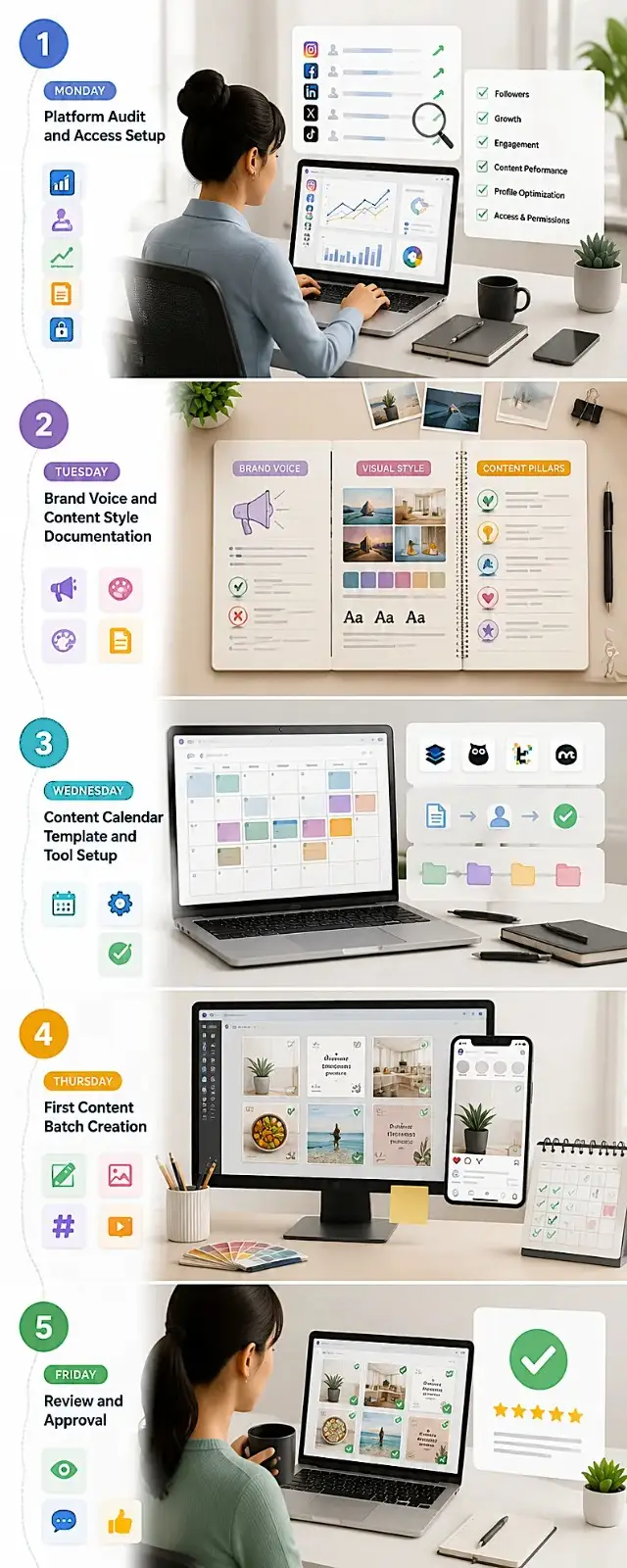
Day 1 – Monday: Platform Audit and Access Setup
Your VA begins by conducting a full audit of your existing social media presence. This covers:
- Current follower counts and growth trajectory across all active platforms
- Post frequency and consistency over the past 90 days
- Top-performing content types and formats
- Engagement rate benchmarks per platform
- Profile completeness: bio, profile photo, cover image, link placement, and contact details
- Existing scheduling tools, login credentials, and access permissions
Time estimate: 3 – 4 hours
The audit output is a concise written summary your VA delivers by end of day, flagging immediate optimization opportunities and establishing baseline metrics for comparison going forward.
Day 2 – Tuesday: Brand Voice and Content Style Documentation
Your VA reviews your existing content library to extract and document your brand’s voice, aesthetic preferences, and content style. Specifically, they build:
- A brand voice one-pager: tone adjectives, vocabulary preferences, and phrases to avoid
- A visual style reference sheet: color palette, font preferences, image style (editorial, lifestyle, graphic), and filter or treatment consistency
- A content pillar map: the 3-5 recurring content themes your social presence will rotate through
Time estimate: 2 – 3 hours
This documentation becomes the operational reference for all content creation going forward.
Day 3 – Wednesday: Content Calendar Template and Tool Setup
Your VA builds the operational infrastructure:
- Sets up or organizes your social media scheduling tool (Buffer, Hootsuite, Later, or Metricool)
- Creates a 30-day content calendar template in your project management workspace (Notion, Asana, or Google Sheets)
- Populates the first two weeks with topic placeholders based on your content pillars
- Confirms approval workflow: which content requires your sign-off before publishing, and what the turnaround expectation is
Time estimate: 2 – 3 hours
Day 4 – Thursday: First Content Batch Creation
With the brand voice guide and content pillars documented, your VA creates the first batch of content for immediate scheduling:
- 5 – 7 posts across your primary platforms
- Captions written in your documented brand voice
- Hashtag sets researched and assigned per platform and topic
- Visual assets sourced from your approved asset library or created using Canva templates
- Posts queued in your scheduling tool for the following week
Time estimate: 4 – 5 hours
Day 5 – Friday: Review and Approval
Your VA sends the first content batch for your review. You provide feedback, approve posts, and align on any adjustments to voice, visuals, or topic direction.
Time estimate (your side): 20 – 30 minutes
Week 2: Standard Operations Begin
By Week 2, the operational infrastructure is in place. Your VA transitions into the standard weekly rhythm that will repeat consistently going forward.
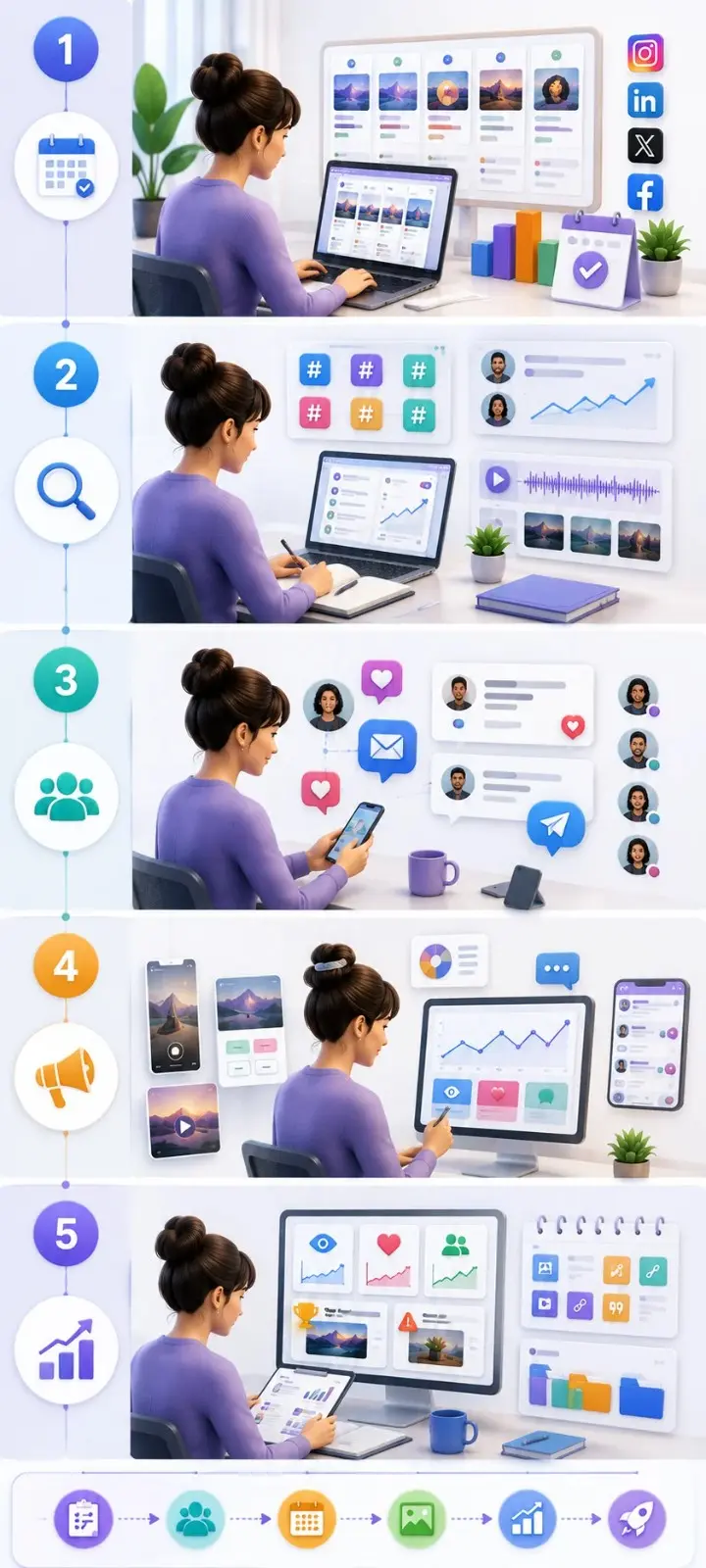
Monday: Content Creation and Scheduling
Monday is the primary content production day. Your VA:
- Reviews the content calendar for the week ahead
- Creates 5 – 10 posts (depending on platform count and posting frequency)
- Writes platform-native captions: longer, story-driven copy for LinkedIn; punchy, emoji-forward captions for Instagram; concise, hook-first text for X (formerly Twitter); and value-forward, keyword-rich descriptions for Pinterest or YouTube
- Sources or creates visual assets for each post
- Schedules all posts in your scheduling tool for the week ahead, with optimal send times pre-set per platform
Time estimate: 4 – 6 hours
Tuesday: Hashtag Research and Content Optimization
Your VA dedicates Tuesday morning to content optimization and research tasks:
- Refreshes hashtag sets for each content pillar, replacing underperforming tags with new tested alternatives
- Reviews competitor and industry accounts for trending topics and content format opportunities
- Identifies 2 – 3 trending audio clips or content formats relevant to your niche (for Reels or TikTok if applicable)
- Updates the content calendar with topic ideas surfaced during research
Time estimate: 2 – 3 hours
Wednesday: Community Management and Engagement
Wednesday is the engagement-first day. Your VA:
- Responds to all comments on posts published in the past 48 – 72 hours
- Handles direct messages: customer inquiries routed to the appropriate team member, general engagement messages responded to directly, and spam flagged and removed
- Proactively engages with your target audience: commenting on relevant posts from industry accounts, participating in trending conversations, and engaging with followers’ content
- Monitors brand mentions and tags, and responds or reposts as appropriate
Time estimate: 2 – 3 hours
This proactive engagement component is frequently underestimated. Consistent outbound engagement – not just responding inbound – is one of the most reliable organic growth drivers on platforms like Instagram and LinkedIn.
Thursday: Mid-Week Performance Check and Story/Short-Form Content
Thursday serves a dual purpose:
Morning – Stories and short-form content: Your VA publishes or schedules any time-sensitive content that benefits from same-week relevance: Instagram Stories, LinkedIn polls, X threads, or platform-specific reactive content tied to news or trends in your niche.
Afternoon – Mid-week performance check: Your VA reviews the week’s published posts:
- Which posts are over- or under-performing relative to your engagement rate benchmark
- Whether any posts require a response, reshare, or follow-up comment to boost algorithmic visibility
- Any comments or DMs that came in overnight or require escalated handling
Time estimate: 2 – 3 hours
Friday: Weekly Analytics Report and Next-Week Planning
Friday is the review, reporting, and planning day. Your VA delivers:
Weekly performance summary covering:
- Total reach and impressions per platform
- Engagement rate per post and platform average
- Follower net change for the week
- Top-performing post of the week with notes on why it worked
- Lowest-performing post with a brief analysis
- Any anomalies, spikes, or notable audience behaviors
Next-week content plan:
- Updated content calendar with the following week’s topics and formats populated
- Any assets needed from you (photos, video footage, product updates, announcements)
- Questions or decisions that require your input before content creation begins Monday
Time estimate: 2 – 3 hours
Your weekly review of this report takes approximately 15 – 20 minutes. You provide feedback, approve the next week’s direction, and supply any needed assets. That is your total weekly time investment in your social media operation.
The Standard Weekly Task Schedule at a Glance
| Day | Primary Focus | Key Deliverables | Time (VA) |
|---|---|---|---|
| Monday | Content creation and scheduling | 5–10 posts queued for the week | 4–6 hrs |
| Tuesday | Research and optimization | Updated hashtag sets, trending topics | 2–3 hrs |
| Wednesday | Community management | Comments, DMs, proactive engagement | 2–3 hrs |
| Thursday | Short-form content and mid-week check | Stories/Reels, performance review | 2–3 hrs |
| Friday | Analytics and planning | Weekly report, next-week content plan | 2–3 hrs |
| Total | — | — | 12–18 hrs/week |
Week 3 and Beyond: Advanced Tasks That Layer In Over Time
Once the standard weekly rhythm is running smoothly – typically by Week 3 or 4 – a skilled social media virtual assistant begins layering in more advanced tasks that compound the results of the baseline execution.

Monthly Content Pillar Review
Every four weeks, your VA conducts a content pillar performance review:
- Which content themes are generating the most engagement and reach
- Whether any pillars need to be retired or replaced based on audience response data
- New content formats or trending topic areas worth testing
Time estimate: 2 – 3 hours per month
Audience Growth Analysis
Beyond weekly follower counts, your VA produces a monthly audience quality report:
- Follower demographic breakdown (where your scheduling or analytics tool provides this data)
- Engagement rate trend over 30, 60, and 90 days
- Identification of high-value followers: accounts with significant reach or influence who are actively engaging with your content
- Recommendations for audience growth tactics based on data
Time estimate: 2 hours per month
Competitor and Trend Monitoring Report
Your VA tracks 3 – 5 competitor or peer accounts monthly and delivers a brief intelligence report:
- New content formats or topics competitors are testing
- Campaigns or announcements generating significant engagement in your niche
- Platform algorithm changes or feature updates that warrant a strategy adjustment
Time estimate: 1.5 – 2 hours per month
User-Generated Content Curation
As your audience grows, your VA begins monitoring for and curating user-generated content (UGC):
- Identifying customer posts that tag or mention your brand
- Requesting repost permissions where appropriate
- Incorporating approved UGC into the content calendar as social proof posts
Time estimate: 1 hour per week (ongoing)
Comparison: Managing Social Media Yourself vs. Delegating to a VA
| Factor | DIY Social Media | Social Media Virtual Assistant |
|---|---|---|
| Weekly time investment | 10–20+ hrs/week | 15–20 min/week (review only) |
| Posting consistency | Irregular, schedule-dependent | Consistent, calendar-driven |
| Response time to comments/DMs | Variable, often delayed | Same-day or next-day |
| Content quality | Variable, fatigue-affected | Consistent, brief-guided |
| Analytics visibility | Rarely reviewed | Weekly structured report |
| Trend monitoring | Ad hoc, reactive | Proactive, systematic |
| Scalability | Low — bottlenecked by your time | High — task scope easily expanded |
| Burnout risk | High | Eliminated |
The difference is not just time savings. It is the structural difference between a social media presence that runs on willpower and one that runs on a documented, staffed operational system.
Platform-Specific Tasks Your VA Handles Each Week
Different platforms require different native behaviors. A skilled social media VA adapts their execution approach by platform rather than using a one-size-fits-all content model.

- Feed posts: 3 – 5 per week, static images or carousel formats
- Stories: Daily or near-daily, mix of repurposed feed content, polls, Q&As, and behind-the-scenes
- Reels: 1 – 3 per week, trending audio, educational or entertaining short-form video
- Hashtag management: 5 – 15 per post, rotated and tested by pillar
- DM responses: daily check-in

- Feed posts: 3 – 4 per week, long-form text posts, document carousels, or short thought-leadership pieces
- Comments on connections’ posts: 5 – 10 per week (proactive engagement)
- Articles or newsletters: 1 per month (if applicable)
- Connection request management: weekly batch review
- Event promotion or resharing company updates

- Page posts: 3 – 5 per week, link shares, video, and native text posts
- Groufacebook-social-media-va-tasksp management (if applicable): daily moderation, weekly prompts
- Ad comment monitoring (if running paid campaigns)
- Event creation and promotion management

X (formerly Twitter)
- Posts/threads: 5 – 10 per week, mix of original content and curated industry shares
- Engagement: daily replies and quote posts in relevant conversations
- List management: industry monitoring lists maintained and reviewed weekly

- Pins: 5 – 15 per week, keyword-optimized descriptions
- Board organization and SEO optimization
- Trend research using Pinterest Trends tool
According to Hootsuite’s global social media benchmarks, brands that post platform-native content – adapted for each platform’s format and culture rather than cross-posted identically – see significantly higher engagement rates across all channels.
What Your Social Media VA Needs From You Each Week
Effective delegation is not zero involvement. It is the right level of involvement at the right moments. Here is exactly what your VA needs from you on a weekly basis:
- Monday (if applicable): Supply any time-sensitive assets – new product photos, event announcements, milestone updates – that need to be incorporated into the week’s content
- Friday (15 – 20 minutes): Review and approve the weekly analytics report; sign off on the following week’s content plan; answer any questions your VA has flagged
- As needed: Respond to escalated DMs or comments your VA has flagged as requiring your personal response
- Monthly: Participate in a 30-minute content direction check-in where you review the content pillar performance and confirm or adjust the strategic direction for the month ahead
Everything else – every post, every caption, every comment, every hashtag, every report – your VA handles independently.
Common Mistakes When Onboarding a Social Media Virtual Assistant

1. Skipping the brand voice documentation step
Without a documented voice guide, your VA writes captions that technically cover the right topics but sound like they came from a different brand. Invest the time in Week 1 to document your tone precisely.
2. Approving content too slowly
If your approval cycle takes three to four days, your VA cannot maintain a consistent publishing schedule. Either approve content in batches once a week with a 24-hour turnaround, or empower your VA to publish within defined guidelines without requiring per-post approval.
3. Giving feedback that is too vague
“This does not feel right” is not actionable feedback. “This caption sounds too formal – we prefer a direct, conversational tone without corporate language” is. Specific, example-backed feedback accelerates voice calibration dramatically.
4. Expecting platform growth in the first 30 days
Organic social media growth compounds over time. The first 30 days establish the infrastructure and baseline. Meaningful, measurable audience growth typically becomes visible in Month 2 and Month 3 of consistent execution.
5. Treating the VA as a content factory, not a content manager
Your VA should contribute ideas, spot trends, and flag opportunities – not just execute a rigid content plan. Give them enough autonomy to bring observations to the table during the Friday planning handoff.
6. Not defining escalation criteria for DMs and comments
Not every message your VA receives requires your personal response. Define clearly: which types of inquiries they handle independently, which require forwarding to your team, and which require your direct attention. Clear escalation criteria prevent both over-escalation and missed opportunities.
Expert Tips for Getting the Most From Your Social Media VA
Tip 1 – Record a 10-minute onboarding video
Walk through your brand, your audience, and your personal content style on camera. A 10-minute video communicates nuance that a written brief often misses – tone, energy, emphasis, and the personality elements that make your brand distinctly yours.
Tip 2 – Build a content asset library
Give your VA a shared folder (Google Drive or Dropbox) with brand-approved photos, logos, brand colors, and video clips. A well-stocked asset library means your VA spends time on strategy and copy, not searching for suitable visuals.
Tip 3 – Start with one platform, then expand
If you are new to VA delegation, start by handing over one platform completely before adding others. This reduces complexity during onboarding and lets you evaluate quality in a controlled way before scaling scope.
Tip 4 – Use a social media scheduling tool with team features
Tools like Buffer, Later, or Metricool allow your VA to create and queue content for your review before publishing. This creates a natural approval checkpoint without requiring real-time collaboration.
Tip 5 – Celebrate wins together
When a post performs exceptionally well, share it with your VA with a note about what worked. Positive reinforcement accelerates learning and builds the kind of creative ownership that makes a VA genuinely invested in your brand’s growth.
How to Measure Your Social Media VA’s Performance
Performance measurement should happen at two cadences: weekly and monthly.

Weekly Metrics to Review
- Posting consistency: did all planned posts publish on schedule?
- Engagement rate: is it at, above, or below platform benchmark?
- Response time: are comments and DMs being addressed within the agreed timeframe?
- Report quality: is the weekly analytics report delivered on time, accurate, and actionable?
Monthly Metrics to Review
- Follower net growth over the month
- Reach and impressions trend (growing, flat, or declining)
- Top-performing content format and pillar
- Engagement rate trend versus the prior month
- Conversion events attributable to social media (link clicks, website visits, DM inquiries)
Use Meta Business Suite for Facebook and Instagram analytics, LinkedIn’s native analytics for LinkedIn, and your scheduling tool’s unified dashboard for cross-platform performance tracking. These tools give your VA the data they need to deliver meaningful, insight-rich reports rather than surface-level vanity metric summaries.
FAQ: Social Media Virtual Assistant Tasks
Q: What are social media virtual assistant tasks?
Social media virtual assistant tasks are the recurring, platform-specific operational activities that keep a brand’s social presence active and growing – including content scheduling, caption writing, hashtag research, community management, performance analytics, and trend monitoring. These tasks follow a structured weekly cycle executed by a trained remote specialist without requiring daily founder involvement.
Q: How many hours per week does a social media virtual assistant work?
A social media VA managing 2 – 3 active platforms typically works 12 – 18 hours per week in a standard operational week. Week 1 onboarding requires 15 – 20 hours. Monthly advanced tasks (competitor analysis, audience growth reporting, content pillar reviews) add an additional 6 – 8 hours per month on top of the weekly base.
Q: Can a social media virtual assistant create graphics and visual content?
Yes – most content-specialized social media VAs work with Canva, Adobe Express, or similar tools to produce branded graphic templates, carousel posts, Story assets, and simple video clips. For complex video editing or brand identity design work, a dedicated designer is typically more appropriate.
Q: How quickly will I see results after hiring a social media virtual assistant?
Infrastructure and consistency improvements are visible within the first 30 days: regular posting cadence, faster response times, and a structured content calendar. Measurable engagement and audience growth improvements typically become visible in Months 2 and 3, as the platform algorithms reward the new consistency pattern.
Q: What platforms can a social media virtual assistant manage?
A skilled social media VA can manage Instagram, LinkedIn, Facebook, X (formerly Twitter), Pinterest, TikTok, and YouTube community features. The specific platform mix depends on where your audience is most active and should be defined clearly during onboarding.
Q: Do I need to provide content ideas to my social media virtual assistant?
Not necessarily. A well-onboarded VA with documented content pillars, a brand voice guide, and access to your industry generates most content ideas independently. You may want to supply time-sensitive business updates (launches, events, milestones) and approve the monthly content direction, but the day-to-day ideation is part of the VA role.
Q: How is a social media virtual assistant different from a social media manager?
A social media manager typically owns both the strategy and the execution, often operates at a senior level, and commands a higher retainer. A social media virtual assistant primarily operates at the execution layer – implementing a defined strategy with precision and consistency. For businesses with a clear strategy that needs reliable execution, a VA delivers exceptional value at a lower cost than a full social media manager.
Build a Social Presence That Runs Without You
Your social media channels should be a consistent, growing asset for your business – not a source of guilt every time you realize you have not posted in two weeks. The week-by-week task system outlined in this article is not theoretical. It is the operational reality of businesses that have made the decision to staff their social media function properly.

The structure is clear: production on Monday and Tuesday, engagement on Wednesday and Thursday, and review and planning on Friday. Every week, without fail, your brand shows up on the platforms where your audience is – with consistent voice, quality content, and active community management.
You spend 15 – 20 minutes reviewing a report on Friday and approving the following week’s direction. Your VA handles everything else.
That is what a properly delegated social media operation looks like. The only variable is whether you build it now or continue managing it yourself for another quarter.
If you are ready to hand off your social media execution to a specialist who makes your brand voice their full-time focus, explore how build and run complete social media systems for growth-focused businesses – week after week, platform after platform.