
An AI-trained virtual marketing assistant differs from a standard VA through the integration of machine learning workflows, predictive analytics interpretation, AI-powered content systems, and automated performance optimization protocols that operate continuously – not reactively. Where a standard VA executes discrete tasks on instruction, an AI-trained VMA applies data intelligence, prompt engineering proficiency, and algorithmic tool mastery to drive compound marketing outcomes across SEO, content, email, and paid channels simultaneously. The result is a fundamentally different execution model: one built for velocity, precision, and scalable ROI rather than task completion alone.
If your current marketing support relies on manual execution without intelligent automation, you are likely leaving measurable growth on the table. Businesses that upgrade to AI-powered virtual marketing assistant services are consistently outpacing competitors still dependent on traditional, reactive support models.
What is an AI-Trained Virtual Marketing Assistant?
Before drawing comparisons, it is important to define the term precisely.
An AI-trained virtual marketing assistant is a remote marketing professional who has developed deep operational fluency with artificial intelligence tools, platforms, and workflows. This goes far beyond knowing how to use ChatGPT occasionally. It means:
- Structuring and deploying advanced prompt frameworks for content generation, research, and optimization
- Operating AI-native SEO platforms (Surfer SEO, Clearscope, MarketMuse) to build topical authority
- Using predictive analytics tools to model campaign performance before spend is committed
- Integrating automation layers across email, CRM, social, and content pipelines
- Interpreting AI-generated data outputs and translating them into strategic marketing decisions
- Continuously updating their AI tool stack as the technology evolves
This professional does not use AI as a shortcut. They use it as a force multiplier – compressing what traditionally took days into hours, while maintaining and often improving quality standards.
The Core Difference: Reactive Execution vs. Intelligent Operation
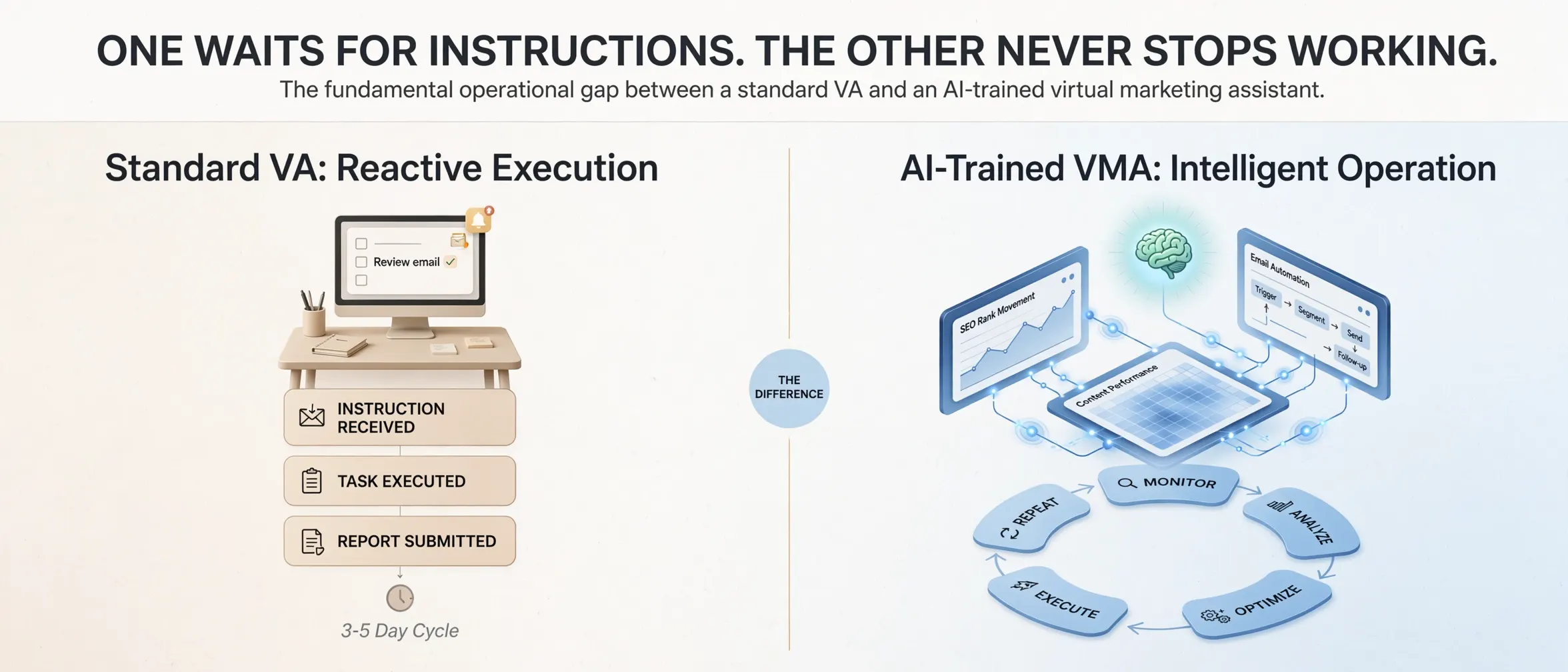
The most fundamental distinction between a standard VA and an AI-trained virtual marketing assistant comes down to one principle: intelligence applied to execution.
A standard VA waits for instructions. An AI-trained VMA anticipates needs, identifies opportunities in data, and structures marketing workflows that self-improve over time.
Here is how that plays out across real marketing functions:
Content Production
Standard VA approach:
- Receives a topic brief
- Writes a draft manually
- Submits for review
- Implements edits
- Publishes
AI-trained VMA approach:
- Conducts AI-assisted keyword and SERP analysis to validate topic demand
- Uses NLP content optimization tools to identify semantic coverage gaps before writing
- Structures content architecture aligned with featured snippet and AI Overview extraction patterns
- Produces first drafts using precision prompt frameworks, then edits for brand voice and accuracy
- Optimizes meta elements, schema markup, and internal linking using automated SEO workflows
- Tracks post-publish performance and iterates based on ranking signal data
The output quality improves. The turnaround time compresses. The strategic alignment strengthens – all simultaneously.

SEO Execution
Standard VA approach:
- Adds meta titles and descriptions manually
- Publishes content and waits for results
AI-trained VMA approach:
- Runs topical authority mapping using AI clustering tools
- Uses predictive rank modeling to prioritize high-ROI keyword opportunities
- Monitors Core Web Vitals, crawl budget, and indexation signals via automated dashboards
- Implements structured data and schema markup to improve SERP feature eligibility
- Conducts continuous content gap analysis against top-ranking competitors
According to Google’s Search Central documentation, content that demonstrates genuine expertise and addresses user intent comprehensively consistently outperforms thin, keyword-focused content. An AI-trained VMA builds content strategies around this principle at scale.
Email Marketing and Automation
Standard VA approach:
- Builds campaign templates
- Sends scheduled emails
- Reports on open rates
AI-trained VMA approach:
- Designs multi-branch behavioral automation sequences triggered by user actions
- Uses AI-powered send-time optimization to maximize open rates per subscriber segment
- Applies predictive segmentation to identify high-intent leads before they self-identify
- A/B tests subject lines, CTAs, and content blocks using statistically significant sample sizes
- Integrates email performance data with CRM pipeline stages to align marketing with sales velocity
The difference in email revenue contribution between these two models is not marginal – it is categorical.
Capability Comparison Table: AI-Trained VMA vs. Standard VA
| Marketing Function | Standard VA | AI-Trained Virtual Marketing Assistant |
|---|---|---|
| Content Creation | Manual drafting from brief | AI-assisted research, NLP optimization, structured prompting |
| SEO | Manual meta updates, basic keyword use | Topical authority mapping, predictive ranking, schema markup |
| Keyword Research | Basic tool use (Google Keyword Planner) | AI clustering, SERP intent analysis, semantic gap mapping |
| Email Marketing | Template building, scheduled sends | Behavioral automation, predictive segmentation, AI send-time optimization |
| Analytics | Pulls reports on request | Proactive KPI monitoring, anomaly detection, predictive modeling |
| Social Media | Schedules content manually | AI-assisted ideation, performance pattern analysis, content repurposing automation |
| CRM Management | Contact updates and list hygiene | AI lead scoring, behavioral tagging, pipeline velocity analysis |
| Ad Support | Writes ad copy, monitors spend | AI creative testing frameworks, audience modeling, bid optimization support |
| Reporting | Static weekly/monthly reports | Dynamic dashboards, real-time alerts, trend forecasting |
| Tool Stack | Standard productivity tools | AI-native marketing platforms + automation integrations |
AI Tools That Separate the Best VMAs from the Rest
Not all VMAs who claim AI proficiency are equal. The most capable AI-trained virtual marketing assistants demonstrate hands-on operational fluency with a defined set of tools.
Content and SEO AI Tools
- Surfer SEO – NLP-powered on-page optimization and content scoring
- Clearscope – Content grading against top-ranking SERP competitors
- MarketMuse – Topical authority planning and content gap analysis
- ChatGPT / Claude – Advanced prompt engineering for research, drafting, and ideation
- Jasper AI – Brand-voice-consistent long-form content production
- Semrush AI Writing Assistant – SEO-integrated content creation workflow
Analytics and Automation Tools
- Google Analytics 4 – Event-based behavioral analytics with predictive audiences
- HubSpot AI features – Lead scoring, content strategy recommendations, email optimization
- Zapier / Make (Integromat) – Cross-platform automation workflow architecture
- Klaviyo AI – Predictive segmentation and send-time intelligence for e-commerce email
- Notion AI – Documentation, process templating, and knowledge base management
Social Media AI Tools
- Lately AI – Long-form content repurposing into social micro-content
- Predis.ai – AI-generated social creatives and performance prediction
- Buffer AI Assistant – Caption generation and posting strategy recommendations
Proficiency across these categories signals a VMA who operates at the intersection of marketing strategy and marketing technology – a combination that standard VAs rarely possess.
Why AI Fluency is Now a Non-Negotiable Marketing Skill
The marketing landscape has shifted structurally. AI is no longer an emerging capability – it is the operational baseline for competitive marketing execution.
Consider these realities:
- Over 75% of marketers now use AI tools regularly in their workflow, according to HubSpot’s State of AI in Marketing Report
- Businesses that integrate AI into marketing workflows report 40-60% improvements in content production speed without sacrificing quality
- AI-native SEO strategies are increasingly required to compete for visibility in Google’s AI Overview results
- Predictive analytics tools are making reactive campaign management obsolete in high-competition verticals
A standard VA hired today without AI fluency is already operating below the performance baseline your competitors are setting. This is not a prediction – it is the current state of the market.
The Compounding ROI Effect
One of the most significant – and least discussed – advantages of an AI-trained VMA is the compounding nature of their output.
Standard VA output: Linear. More hours = more tasks completed.
AI-trained VMA output: Exponential. Automated workflows, templated AI processes, and optimized pipelines continue delivering value even when the VMA is not actively working. A behavioral email sequence built in week one keeps nurturing leads in week 40. An AI-optimized content cluster published in Q1 keeps generating organic traffic through Q4 and beyond.
This compounding effect fundamentally changes the ROI conversation.
What a Standard VA Simply Cannot Replicate
It is important to be direct here. A standard VA working hard and diligently is not the same as an AI-trained virtual marketing assistant. Effort does not substitute for capability architecture.
Here are the specific functions a standard VA genuinely cannot replicate without AI training:
1. Predictive Lead Scoring
Identifying which leads in your CRM are most likely to convert – based on behavioral signals, engagement patterns, and demographic data – requires AI tool fluency. Standard VAs manage contacts. AI-trained VMAs identify your next customers.
2. Topical Authority Architecture
Building a content strategy that earns sustained organic search dominance requires AI-assisted topic clustering, intent mapping, and semantic coverage analysis. This is not a manual task – it is an algorithmic one.
3. Behavioral Automation Engineering
Designing multi-branch automation sequences that respond to real user behavior in real time requires both technical platform knowledge and strategic thinking. Standard VAs build campaigns; AI-trained VMAs build systems.
4. Real-Time Anomaly Detection
An AI-trained VMA monitors performance dashboards with automated alert frameworks – catching a 40% drop in email deliverability, a spike in CPC, or a crawl indexation error before it costs you traffic or revenue. Standard VAs check dashboards when asked.
5. AI-Assisted Competitive Intelligence
Using tools like Semrush, Ahrefs, and AI-powered SERP analysis to continuously monitor competitor content strategies, backlink acquisition, and ranking movements – and adjusting your strategy accordingly – is a systematic capability standard VAs rarely possess.
Industry-Specific Impact: AI-Trained VMA Performance by Sector
SaaS and Technology Companies
AI-trained VMAs in SaaS environments manage product-led content strategies, automate onboarding email sequences, build SEO content clusters around high-intent feature keywords, and track free-trial-to-paid conversion signals using behavioral analytics. The output directly impacts MRR growth.
E-Commerce Brands
Predictive segmentation, abandoned cart automation, AI-generated product description optimization, and dynamic ad creative testing are standard functions for an AI-trained VMA supporting an e-commerce operation. These functions generate direct revenue impact that is measurable within weeks.
Professional Services and B2B Firms
Thought leadership content produced at scale, LinkedIn automation sequences, lead magnet performance optimization, and CRM pipeline velocity analysis are the core deliverables. The AI layer ensures these activities compound over time rather than plateauing.
Healthcare and Wellness Providers
Compliant content production at scale, local SEO optimization using AI geo-targeting tools, and patient education email automation are areas where AI-trained VMAs deliver value that standard VAs cannot match – especially under strict regulatory content constraints.
How to Identify a Genuinely AI-Trained Virtual Marketing Assistant
Not every VA who lists “AI tools” on their profile has real operational fluency. Here is how to qualify candidates accurately:
Step 1: Request a tool proficiency audit
Ask candidates to document their specific AI tools, how they use them, and provide examples of outputs they have generated. Vague answers signal surface-level familiarity.
Step 2: Assign a practical assessment
Give a real brief – a blog post optimization task, an email sequence design, or a keyword cluster exercise – and ask them to complete it using their AI workflow. The process reveals true capability.
Step 3: Evaluate prompt engineering quality
Ask to see the prompts they use for content creation, research, or SEO tasks. High-quality prompt engineering is a strong signal of genuine AI fluency. Generic prompts indicate basic usage.
Step 4: Assess their understanding of AI limitations
The best AI-trained VMAs know exactly where AI fails – and compensate with human judgment. Ask them: “Where do you not use AI in your workflow, and why?” Strong answers reveal sophisticated practitioners.
Step 5: Review their approach to AI output quality control
AI-generated content requires fact-checking, brand voice calibration, and editorial refinement. Ask how they manage this. An AI-trained VMA with rigorous QA standards is far more valuable than one who publishes AI output without review.
Step 6: Check for ongoing AI education habits
The AI tool landscape changes monthly. Ask which AI marketing newsletters, courses, or communities they follow. Continuous learning is a non-negotiable trait in this domain.
Common Mistakes Businesses Make When Evaluating AI Marketing Support
Many businesses invest in AI-powered marketing support and still fail to get results – not because AI VMAs do not work, but because of avoidable evaluation and onboarding errors.
YOU RESULTS.
PERFORMANCE
YOUR VMA PARTNERSHIP
Mistake 1: Confusing AI tool access with AI fluency
Giving a standard VA access to ChatGPT does not create an AI-trained VMA. Tool access without strategic fluency produces mediocre AI-generated output that performs poorly.
Mistake 2: Prioritizing cost over capability
AI-trained VMAs command higher rates than generalist VAs – and for good reason. The ROI difference between the two profiles routinely exceeds the cost difference by a significant margin.
Mistake 3: Not defining AI-specific KPIs
If you hire an AI-trained VMA but measure them only on task completion, you miss the true value. Define AI-specific KPIs: content ranking velocity, automation conversion rates, lead scoring accuracy, and time-to-publish compression.
Mistake 4: Treating AI workflows as set-and-forget
AI tools require calibration, prompt refinement, and regular updates as algorithms evolve. Build in structured optimization time rather than expecting AI workflows to run indefinitely without maintenance.
Mistake 5: Ignoring the human layer
The most effective AI-trained VMAs combine AI efficiency with human strategic judgment. Businesses that push for maximum AI automation at the expense of human oversight typically produce content and campaigns that feel generic, off-brand, or factually unreliable.
Expert Tips: Getting Maximum ROI from an AI-Trained VMA
Tip 1: Co-build your AI workflow documentation from day one
Ask your VMA to document every AI workflow they build for your business – prompts, tools, processes, and outputs. This creates institutional knowledge that survives personnel changes and enables rapid onboarding of future team members.
Tip 2: Set a monthly AI audit cadence
Schedule a monthly 30-minute review of which AI tools and workflows are being used, what results they are generating, and which need updating. The AI tool landscape evolves fast; your workflow stack should too.
Tip 3: Integrate AI VMA outputs into your broader marketing stack
AI-generated content, automated emails, and analytics reports are most powerful when integrated with your CRM, paid ad platforms, and sales pipeline data. Ensure your VMA has full-stack access to maximize cross-channel intelligence.
Tip 4: Use AI for pattern recognition, humans for strategy
Let your AI-trained VMA use AI tools to surface patterns, generate options, and execute workflows – but keep final strategic decisions in human hands. This hybrid model consistently outperforms both fully manual and fully automated approaches.
Tip 5: Benchmark AI output quality quarterly
Run quarterly audits comparing AI-assisted content performance (rankings, engagement, conversion) against baseline metrics. This creates an evidence base for workflow refinement and demonstrates ROI to stakeholders.
Side-by-Side ROI Comparison
| Business Outcome | Standard VA (6-Month Trajectory) | AI-Trained Virtual Marketing Assistant (6-Month Trajectory) |
|---|---|---|
| Blog content output | 4-6 posts/month (manual) | 10-16 posts/month (AI-assisted, SEO-optimized) |
| Organic traffic growth | 5-10% incremental | 25-50% (topical authority + AI SEO) |
| Email campaign ROI | Standard open rate improvements | Predictive segmentation + 20-35% revenue lift |
| Lead nurturing | Manual sequence management | Behavioral automation + continuous optimization |
| Reporting turnaround | 3-5 days for monthly report | Real-time dashboards + automated weekly summaries |
| Content ranking velocity | 3-6 months average | 6-10 weeks (AI-optimized topical clusters) |
| Campaign optimization cycles | Monthly manual review | Continuous automated monitoring + weekly refinement |
Frequently Asked Questions (FAQ)
Q1: What is an AI-trained virtual marketing assistant?
An AI-trained virtual marketing assistant is a remote marketing professional with advanced operational fluency in artificial intelligence tools, automation platforms, and data-driven marketing systems. They combine human strategic judgment with AI-powered workflows to execute marketing functions at higher speed, quality, and scale than traditional VAs.
Q2: How is an AI-trained virtual marketing assistant different from a regular VA?
The core difference lies in capability architecture. A regular VA executes manual tasks on instruction. An AI-trained VMA designs and operates intelligent marketing systems – including automated content pipelines, predictive email sequences, AI-assisted SEO strategies, and real-time performance monitoring – that continue generating value continuously.
Q3: What AI tools should a virtual marketing assistant be proficient in?
The most important AI tools include Surfer SEO or Clearscope (SEO content optimization), ChatGPT or Claude (prompt-engineered content and research), HubSpot AI (lead scoring and email optimization), Klaviyo AI (predictive email segmentation), Google Analytics 4 (predictive audiences and behavioral data), and Zapier or Make (cross-platform automation workflows).
Q4: Is an AI-trained VMA more expensive than a standard VA?
Yes – and the cost difference is almost always justified by ROI. AI-trained VMAs typically command 30-60% higher rates than generalist VAs, but they generate proportionally higher returns through content ranking velocity, email revenue lift, lead nurturing efficiency, and reduced time-to-results across all marketing channels.
Q5: Can a standard VA become AI-trained?
Yes, but it requires deliberate, structured learning – not casual tool exposure. Genuine AI fluency involves mastering prompt engineering, understanding AI tool limitations, building automation workflows, and continuously updating skills as the AI marketing stack evolves. Many VAs claim AI knowledge; far fewer can demonstrate it operationally.
Q6: How do I verify that a VMA is genuinely AI-trained?
Assign a practical assessment using real marketing tasks. Review their prompt frameworks, workflow documentation, and tool proficiency examples. Ask them to explain where they do not use AI and why. The depth and specificity of their answers will quickly distinguish genuine AI fluency from surface-level tool familiarity.
Q7: What industries benefit most from an AI-trained virtual marketing assistant?
SaaS companies, e-commerce brands, B2B professional services, healthcare providers, and fast-growing startups benefit most. Any industry with high content volume requirements, complex lead nurturing needs, or significant SEO investment will see disproportionate returns from AI-trained marketing support.
The Capability Gap Is Real – and It Is Widening
The question is no longer whether AI fluency matters in marketing support – it clearly does. The question is whether your business captures that advantage or watches competitors do so while you rely on execution models that the market has already moved beyond.

An AI-trained virtual marketing assistant brings a fundamentally different operational architecture: one defined by intelligent automation, predictive analytics, AI-native content systems, and compound growth trajectories rather than linear task completion. The skill gap is real. The ROI difference is measurable. And the compounding nature of AI-assisted marketing means the earlier you make the switch, the greater the long-term advantage.
If you are ready to replace reactive, manual marketing execution with an intelligent, scalable system built for results, and discover what modern virtual marketing support actually looks like in practice.