
A virtual marketing assistant (VMA) executes a structured portfolio of revenue-generating marketing operations remotely – spanning content production, SEO execution, multi-channel campaign management, performance analytics, and CRM administration – all functioning as an integrated extension of your in-house team. Their daily workflow is governed by editorial calendars, campaign sprints, and KPI dashboards, making them far more than task-based freelancers.

Unlike generalist virtual assistants, a VMA operates with domain-specific expertise in digital marketing strategy, enabling businesses to scale output without scaling headcount.
Still wondering whether a VMA is worth the investment? If your marketing pipeline is stalling due to bandwidth constraints, a professional Virtual Marketing Assistant service could be the operational shift your business needs.
What Exactly Is a Virtual Marketing Assistant?
A virtual marketing assistant is a remote marketing professional who supports businesses with day-to-day marketing execution. They bridge the gap between strategy and implementation – taking your marketing plan off the whiteboard and turning it into measurable results.
Unlike a traditional in-house hire, a VMA works flexibly – whether part-time, full-time, or on a project basis – and typically brings specialized skills in:
- Content marketing – blog writing, copywriting, and editorial management
- Social media management – scheduling, engagement, and growth strategies
- Search engine optimization (SEO) – on-page optimization, keyword research, and link building
- Email marketing – campaign setup, list segmentation, and automation flows
- Paid advertising support – ad copy, audience targeting, and reporting
- Analytics and reporting – tracking KPIs, compiling dashboards, and performance insights
- CRM management – contact hygiene, pipeline updates, and lead nurturing sequences
They don’t just complete tasks – they own workflows.
A Real Day in the Life: What Does a Virtual Marketing Assistant Do?
This is where most articles give you a vague list. Instead, here is an honest, hour-by-hour breakdown of what a VMA actually does during a standard workday.
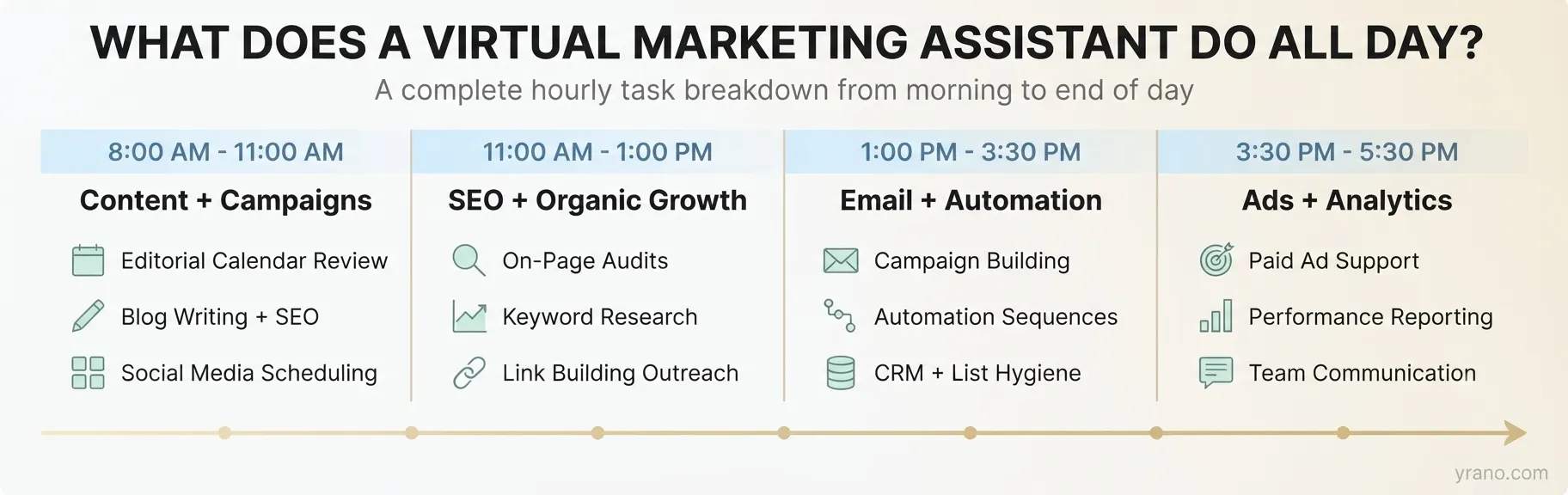
Morning Block (8:00 AM – 11:00 AM): Content and Campaign Execution
The first part of the day is typically devoted to high-focus, deep-work tasks.
1. Reviewing the Editorial Calendar The VMA checks what content pieces are due, what campaigns are launching, and what approvals are pending. This sets the daily execution priority.
2. Writing and Editing Blog Content Most VMAs spend one to two hours producing long-form content – writing SEO-optimized blog posts, updating existing articles, or editing drafts from subject matter experts. This includes:
- Conducting keyword research using tools like Ahrefs or SEMrush
- Structuring posts with proper H2/H3 hierarchy
- Adding internal links, meta descriptions, and image alt text
- Formatting for readability (short paragraphs, bullet points, transition sentences)
3. Scheduling Social Media Posts Using platforms like Buffer, Hootsuite, or Later, the VMA queues up content across LinkedIn, Instagram, Facebook, and X (formerly Twitter). They also repurpose long-form content into micro-content – turning blog posts into carousels, quote graphics, or short-form video scripts.
Mid-Morning Block (11:00 AM – 1:00 PM): SEO and Organic Growth Tasks
4. On-Page SEO Audits The VMA runs site audits, identifies technical SEO issues, and resolves them – whether that means fixing broken links, improving meta tags, updating image filenames, or improving page load speed signals.
5. Keyword Research and Competitive Analysis Staying ahead of competitors requires consistent research. A skilled VMA monitors keyword rankings, identifies content gaps, and recommends new topic clusters aligned with search intent.
6. Link Building Outreach Many VMAs handle outreach campaigns – identifying link-building opportunities, drafting personalized outreach emails, and tracking responses to build the site’s domain authority.
Afternoon Block (1:00 PM – 3:30 PM): Email Marketing and Automation
7. Building and Sending Email Campaigns This includes drafting email copy, designing templates in platforms like Mailchimp, Klaviyo, or ActiveCampaign, segmenting audiences, and setting up A/B tests.
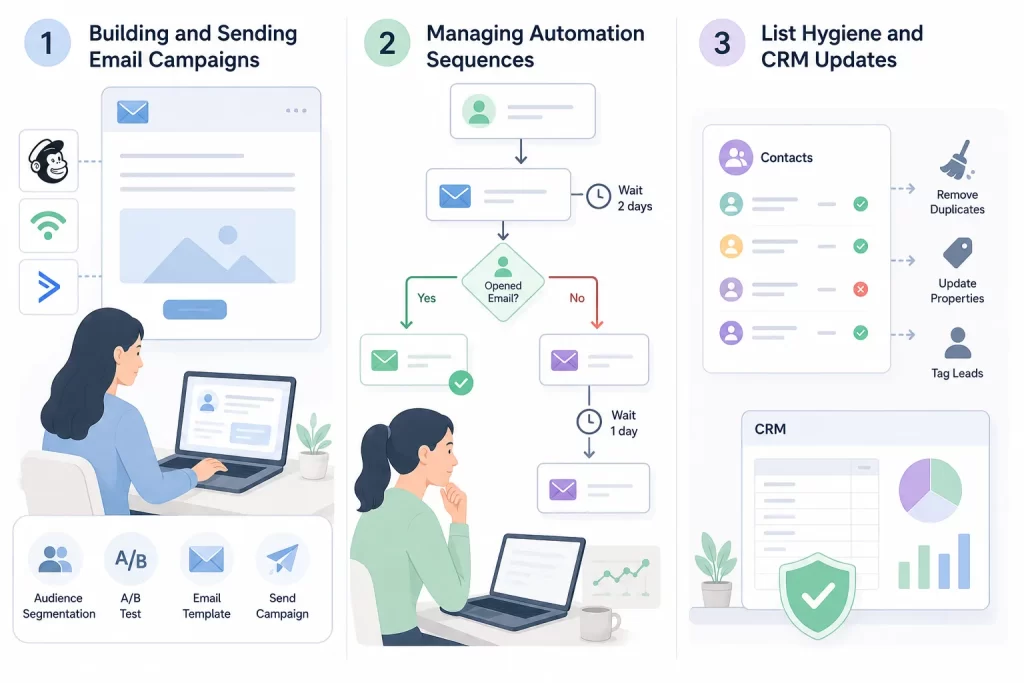
8. Managing Automation Sequences VMAs build drip campaigns and lead nurturing sequences – ensuring the right message reaches the right prospect at the right time. This often involves mapping customer journey stages and writing conversion-focused email copy.
9. List Hygiene and CRM Updates Cleaning the contact database is unglamorous but critical. VMAs remove duplicate records, update contact properties, tag leads by behavior, and ensure CRM data integrity for accurate reporting.
Late Afternoon Block (3:30 PM – 5:30 PM): Paid Ads, Analytics, and Communication
10. Paid Advertising Support While VMAs are rarely the primary media buyer, many provide strong support by:
- Writing and A/B testing ad copy
- Creating ad creatives in Canva or Adobe tools
- Monitoring campaign performance and flagging anomalies
- Preparing spend summaries and ROAS reports for review
11. Analytics and Performance Reporting This is one of the most valuable daily tasks. A VMA:
- Pulls data from Google Analytics 4, Search Console, and ad platforms
- Compares performance against monthly KPI benchmarks
- Highlights wins, identifies underperforming content, and suggests optimizations
- Builds weekly/monthly performance decks for client or leadership review
12. Team Communication and Project Management VMAs coordinate actively. They respond to Slack threads, update task cards in Asana or Trello, attend brief standups, and document completed work. Clear communication keeps campaigns moving without micromanagement.
Complete Task Breakdown Table: What a VMA Does Daily vs. Weekly
| Task Category | Daily Tasks | Weekly Tasks |
|---|---|---|
| Content Marketing | Write/edit blog posts, repurpose content | Review content calendar, brief new topics |
| Social Media | Schedule and post content, monitor engagement | Analyze audience growth, plan monthly themes |
| SEO | Fix on-page issues, update meta data | Keyword tracking, competitor gap analysis |
| Email Marketing | Review open/click rates, clean lists | Build campaigns, set up automation flows |
| Paid Advertising | Monitor ad spend, A/B test creatives | Compile ROAS reports, adjust targeting |
| Analytics | Check KPI dashboards | Build performance reports |
| CRM | Update contact records, tag leads | Audit pipeline stages, remove duplicates |
| Communication | Respond to team messages, update tasks | Attend strategy calls, document processes |
Virtual Marketing Assistant Skills: A Comparison
Generalist VA vs. Virtual Marketing Assistant
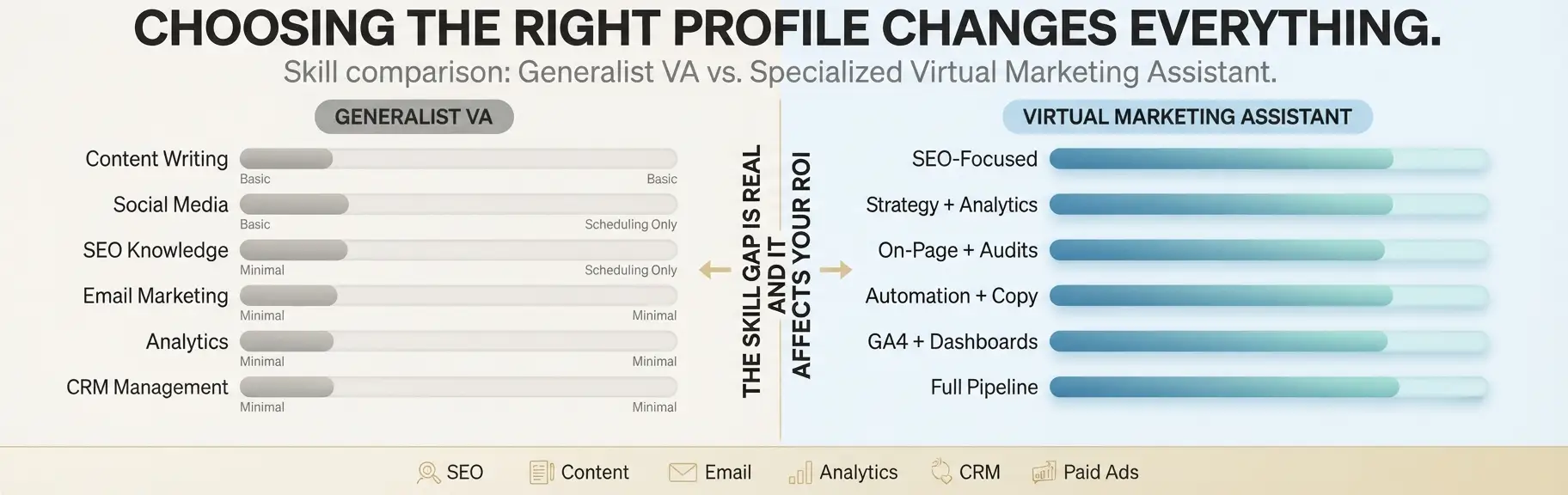
| Skill Area | Generalist VA | Virtual Marketing Assistant |
|---|---|---|
| Content writing | Basic | Advanced – SEO-focused |
| Social media | Scheduling only | Strategy + scheduling + analytics |
| SEO knowledge | Minimal | Keyword research, on-page, audits |
| Email marketing | Sending campaigns | Automation, segmentation, copy |
| Analytics | None or basic | GA4, Search Console, ad dashboards |
| CRM management | Contact updates | Full pipeline + lead nurturing |
| Ad campaign support | Not typical | Ad copy, creatives, reporting |
| Marketing strategy input | Rarely | Frequently |
The distinction matters. Hiring the wrong profile creates execution gaps – particularly in SEO and analytics – that quietly stall growth.
What Industries Benefit Most from Virtual Marketing Assistants?
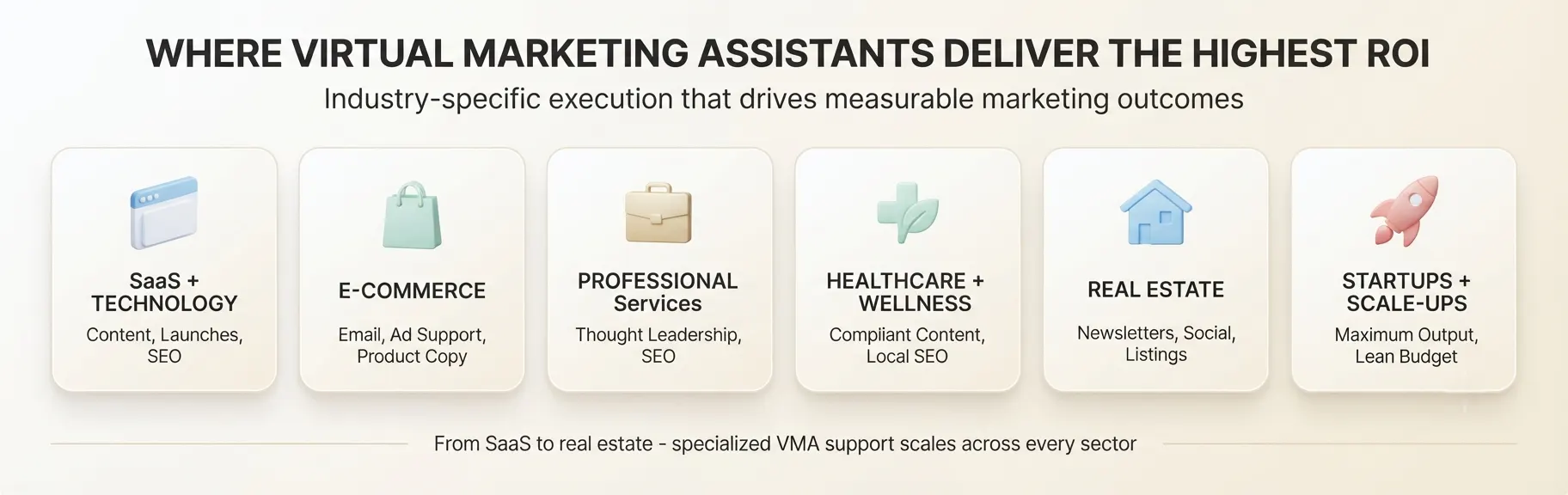
A virtual marketing assistant brings structured value across virtually any sector, but the ROI is especially strong in:
- SaaS and technology companies – constant demand for content, product launches, and SEO
- E-commerce brands – email automation, product copy, and ad support
- Professional services firms – law, consulting, and financial advisory brands building thought leadership
- Healthcare and wellness providers – compliant content marketing and local SEO
- Real estate agencies – social content, email newsletters, and listing promotion
- Startups and scale-ups – maximum marketing output without full-time hiring costs
Common Mistakes Businesses Make When Hiring a VMA
Even companies with good intentions make avoidable mistakes. Here are the most frequent ones:
1. Hiring for tasks instead of outcomes Listing 40 random tasks in a job brief does not create clarity. Define the marketing outcomes you need – leads, organic traffic, email revenue – and hire backward from there.
2. Skipping the onboarding process A VMA can only perform as well as the systems and context you give them. Skipping brand guidelines, tone documents, and access setup wastes the first several weeks.
3. Expecting strategy without providing it VMAs execute strategy brilliantly – but most are not chief marketing officers. Provide a clear strategy framework and let them own execution.
4. Micromanaging output instead of monitoring KPIs Set measurable KPIs and track them. Reviewing every single task output daily is inefficient and demotivating. Trust the process.
5. Underutilizing their full skill set Many businesses hire a VMA for social media and never ask them to help with email automation, content repurposing, or SEO – leaving significant value on the table.
Expert Tips for Getting Maximum Value from Your Virtual Marketing Assistant
Businesses that get outsized results from their VMAs tend to share these practices:
Tip 1: Document everything from day one Create a shared knowledge base (Notion, Google Drive) with brand voice guidelines, audience personas, competitor notes, and campaign templates. This dramatically accelerates VMA productivity.
Tip 2: Use a weekly priority sprint structure Rather than sending ad hoc requests throughout the week, hold one brief planning session to set the top five priorities. This keeps the VMA focused and accountable.
Tip 3: Give them access to analytics, not just tools VMAs who can see performance data make better creative and strategic decisions. Access to GA4, Search Console, and email dashboards is non-negotiable.
Tip 4: Build feedback loops, not approval bottlenecks Review completed work with specific, documented feedback. Over time, this builds a highly calibrated collaborator who requires less revision – not more.
Tip 5: Leverage their platform expertise Ask your VMA which tools they know best. Many bring platform expertise (HubSpot, Klaviyo, Canva, SEMrush) that your business may not be using to its full potential.
How to Know You Are Ready to Hire a Virtual Marketing Assistant
You are likely ready to hire a VMA if:
- You are consistently missing content deadlines
- Your social media presence is inconsistent or inactive
- Email campaigns are not going out on schedule
- Your analytics dashboards are not being reviewed regularly
- Your marketing team is small but your growth targets are large
- You are spending time on execution instead of strategy and leadership
According to HubSpot’s State of Marketing Report, marketing teams that leverage specialized outsourced support consistently outperform those relying solely on small in-house teams for execution-heavy tasks.
Step-by-Step: How to Onboard a Virtual Marketing Assistant Successfully
Follow this structured onboarding framework to maximize early performance:
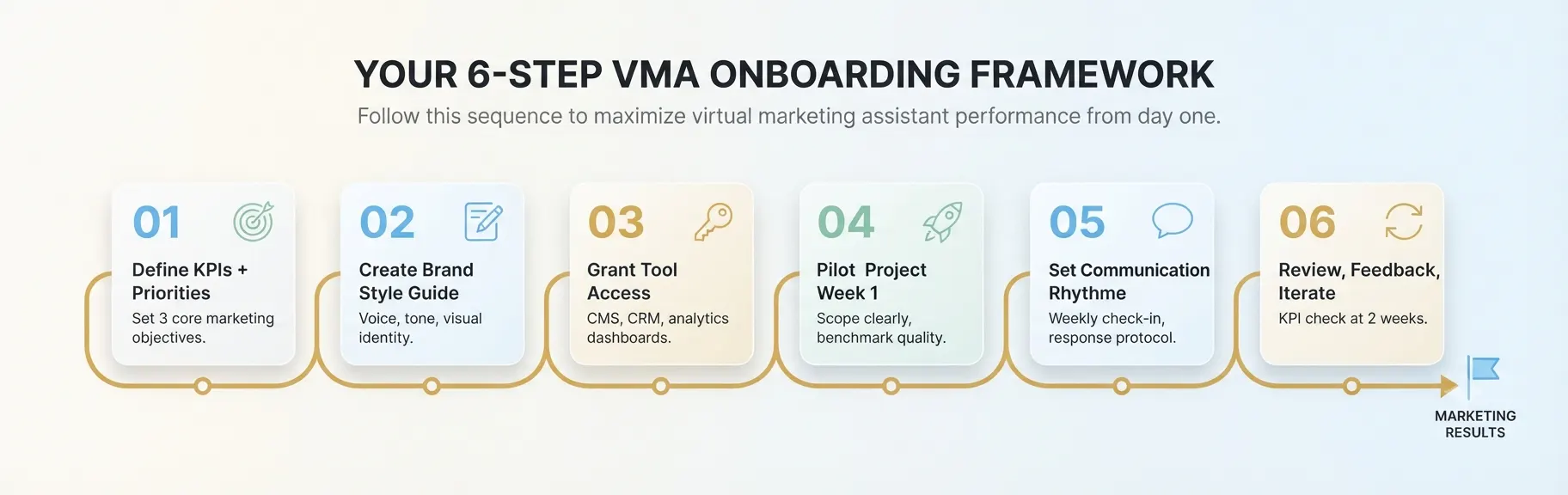
Step 1: Define your marketing priorities and KPIs Before hiring, document your top three marketing objectives and the KPIs that measure them. This becomes your VMA’s performance framework.
Step 2: Create a brand and content style guide Document your brand voice, tone guidelines, visual identity rules, and approved messaging. Share this during day one onboarding.
Step 3: Provide platform access and tool documentation Grant access to all required tools – CMS, CRM, social schedulers, email platforms, and analytics dashboards – with proper permission levels.
Step 4: Assign a pilot project in week one Start with a focused, well-scoped project (e.g., write three blog posts, set up one email automation sequence) to establish quality benchmarks.
Step 5: Establish a communication cadence Set a recurring weekly check-in (15-30 minutes) and a clear protocol for urgent questions. Agree on response time expectations upfront.
Step 6: Review, give feedback, and iterate After the first two weeks, review output against your KPIs. Document what is working and what needs adjustment. Build this feedback into your regular workflow.
Frequently Asked Questions (FAQ)
Q1: What does a virtual marketing assistant do on a daily basis? A virtual marketing assistant handles a structured set of daily marketing tasks including writing SEO-optimized content, scheduling and managing social media posts, executing email campaigns, monitoring ad performance, updating CRM records, and compiling analytics reports. Their daily workflow is guided by an editorial calendar and campaign sprint structure.
Q2: What is the difference between a virtual assistant and a virtual marketing assistant? A generalist virtual assistant handles administrative tasks like scheduling, data entry, and inbox management. A virtual marketing assistant specializes in marketing execution – including SEO, content creation, email automation, paid advertising support, and performance analytics. The skill sets are fundamentally different.
Q3: How many hours per week does a virtual marketing assistant work? This depends entirely on your business needs. VMAs can work as few as 10-15 hours per week for smaller businesses or up to 40+ hours for brands with high-volume marketing operations. Most businesses start with 20 hours per week and scale up based on output requirements.
Q4: What tools does a virtual marketing assistant typically use? Common tools include Google Analytics 4, Google Search Console, SEMrush or Ahrefs (SEO), Mailchimp/Klaviyo/ActiveCampaign (email), Buffer/Hootsuite (social), HubSpot or Salesforce (CRM), Canva or Adobe (design), and Asana/Trello (project management).
Q5: How do I measure the performance of a virtual marketing assistant? Track KPIs directly tied to your marketing objectives – organic traffic growth, email open and click-through rates, social media engagement rates, lead generation volume, content publishing frequency, and campaign ROAS. Set a 30-day baseline during onboarding and review monthly.
Q6: Is a virtual marketing assistant suitable for small businesses? Absolutely. Small businesses often benefit the most because a VMA provides enterprise-level marketing execution without the cost of a full-time in-house hire. According to LinkedIn’s Workforce Insights, flexible remote talent models are among the fastest-growing hiring strategies for small and mid-sized businesses.
Q7: What should I look for when hiring a virtual marketing assistant? Prioritize domain-specific experience (content, SEO, email, or paid ads – depending on your needs), platform proficiency, portfolio evidence of results, communication skills, and the ability to work within a defined KPI framework. A trial project in the first week is always recommended.
Stop Guessing, Start Delegating
Now you know exactly what a virtual marketing assistant does – from the first task of the morning to the final analytics review of the day. They are not glorified schedulers. They are structured, skilled marketing operators who can take your content engine, SEO pipeline, email program, and reporting infrastructure from chaotic to consistent.
The businesses winning right now are not working harder – they are working smarter, by deploying specialized remote talent that executes at the highest level every single day.
If you are ready to stop losing time on execution and start scaling your marketing output, explore built for businesses that are serious about growth. The right VMA does not just check boxes – they move the needle.
Pingback: 22 WordPress Tasks to Delegate to a Virtual Marketing Assistant Today
Pingback: Email Marketing Virtual Assistant Tasks: 16 to Delegate