
A real estate virtual marketing assistant is a remote marketing operator who runs lead capture, CRM nurture sequences, listing promotion, and performance reporting on a fixed monthly cadence. Each month, this role converts scattered marketing tasks into a repeatable top-of-funnel system: sourcing new inquiries, re-engaging dormant contacts, publishing local-intent content, and routing warm responses to the agent for appointment setting. The result is a predictable flow of qualified buyer and seller conversations without the cost and management load of an in-house marketing hire.
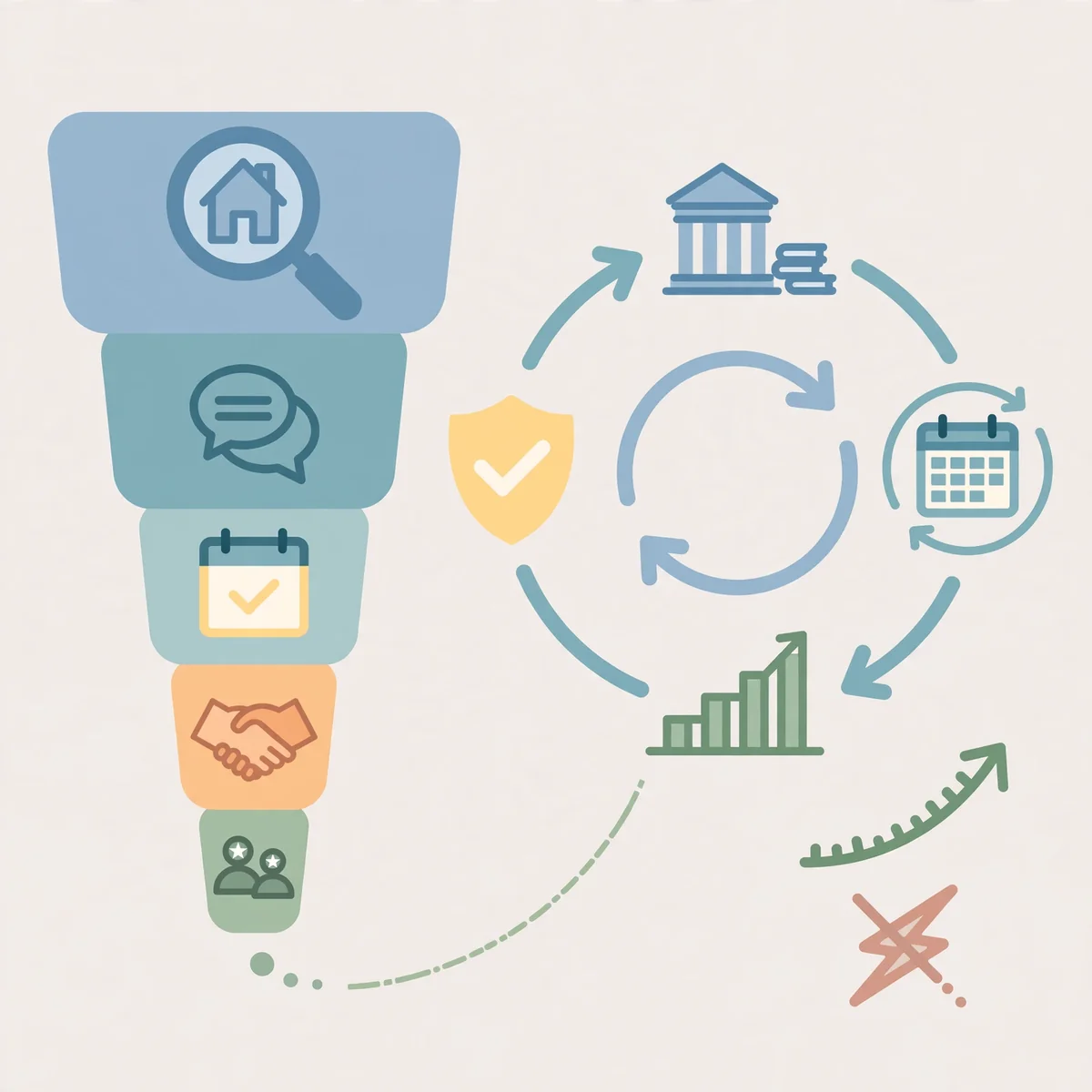

Agents who want this system without assembling a team often start with managed funnel operations and CRM automation support, which pairs trained remote specialists with a documented monthly plan. That structure matters because pipeline problems rarely come from a lack of effort. They come from inconsistent execution. This guide shows exactly what the work looks like, week by week, so you can judge it, delegate it, and measure it.
Quick Answer: What Does a Real Estate Virtual Marketing Assistant Do Each Month?
In short, a real estate virtual marketing assistant handles the recurring marketing work that fills an agent’s calendar with conversations. A typical month includes these seven duties:
- Capture new leads through landing pages, lead magnets, ad campaigns, and profile optimization.
- Clean and segment the CRM so every contact receives relevant messages.
- Send nurture emails and text-ready scripts to past clients, sphere contacts, and new inquiries.
- Publish social and local content that keeps the agent visible in their farm area.
- Promote active and sold listings across email, social, and the website.
- Update the website and Google Business Profile with fresh listings, reviews, and offers.
- Report on results and adjust next month’s plan based on lead quality, not vanity metrics.
Consequently, the agent spends time on showings, listing presentations, and negotiations, while the assistant keeps the machine running behind the scenes.

What Is a Real Estate Virtual Marketing Assistant?
A real estate virtual marketing assistant is a remote professional who executes marketing tasks for an agent, team, or brokerage. Unlike a general admin helper, this person specializes in lead generation, content, email, CRM management, and campaign reporting.
Here is what the role includes and what it does not:
- Includes: campaign setup, email builds, social scheduling, CRM hygiene, website updates, listing promotion, and reporting.
- Includes: following your brand voice, compliance rules, and monthly priorities.
- Does not include: negotiating contracts, giving legal advice, or replacing the agent in client conversations.
- Does not include: random one-off tasks with no tie to pipeline.
For a deeper look at the daily rhythm of this role, see this task-by-task breakdown of a typical VMA workday. It shows how hours translate into deliverables.
Why the “Real Estate” Specialization Matters
Real estate marketing runs on timing, geography, and trust. A specialist already understands these realities:
- Listings move fast, so promotion must go out within hours.
- Buyers and sellers search by neighborhood, school zone, and price band.
- Compliance matters, because advertising and email rules apply to every campaign.
- Referrals and past clients drive a large share of repeat business, so database care is not optional.
In other words, a specialist ships useful work faster because there is far less ramp-up time.
Why Agent Pipelines Dry Up Without a Monthly Marketing System
Most agents do not run out of skill. They run out of consistency. When a busy closing week hits, marketing stops, and the pipeline pays for it sixty days later.

Several patterns show up again and again:
- Feast-or-famine cycles: Marketing happens only when business is slow.
- Neglected databases: Past clients and sphere contacts hear nothing for months.
- Scattered tools: Leads sit in email, social inboxes, and portal dashboards with no single view.
- No measurement: The agent cannot say which channel produced the last three appointments.
Meanwhile, buyer and seller behavior keeps shifting. The National Association of Realtors research library tracks how consumers find agents and how they search for homes, and the findings consistently reward agents who stay visible and responsive. A monthly system answers that reality with steady, scheduled action.
Illustrative planning model (not a benchmark): Suppose a campaign cycle produces 60 inquiries. If 40% engage, you have 24 conversations. If 25% of those become appointments, you have 6 appointments. If one in three signs an agreement, that is 2 new clients. Small gains at each stage compound quickly, which is why consistent monthly execution beats occasional bursts.
The Monthly Pipeline Workflow: What a Real Estate Virtual Marketing Assistant Does Week by Week
The strongest results come from a fixed rhythm. Below is a practical template you can adapt to your market, team size, and tools.
| Week | Focus | Key Tasks | Deliverable |
|---|---|---|---|
| Week 1 | Lead capture and database health | Refresh landing pages, review ad campaigns, tag and segment CRM contacts, set the month’s offer | Clean CRM, live lead capture assets |
| Week 2 | Content and visibility | Draft and schedule social posts, publish a local market update, update Google Business Profile | Content calendar published |
| Week 3 | Nurture and listing promotion | Send email sequences, promote active and sold listings, follow up on inquiries | Campaigns sent, warm lead list for the agent |
| Week 4 | Reporting and optimization | Pull metrics, review lead quality, plan next month, refresh underperforming assets | Monthly report and next-month plan |
Week 1: Build the Foundation for New Leads
First, the assistant audits what already exists. Then the work moves quickly into setup.
- Review last month’s lead sources and discard what did not perform.
- Tag contacts by stage: new inquiry, active buyer, active seller, past client, sphere.
- Refresh the lead magnet, such as a home value report or buyer checklist.
- Confirm that every form routes into the CRM without errors.
As a result, the agent starts the month with a clean list and working capture points.
Week 2: Publish Content That Builds Local Visibility

Next comes content. The assistant plans and schedules posts tied to neighborhoods, market updates, and recent results.
- Draft three to five social posts with approved photos and captions.
- Publish a short local market update for email and the website.
- Update the Google Business Profile with new photos, posts, and recent reviews.
Moreover, reusing one market update across email, social, and the site saves time without reducing quality.
Week 3: Nurture Leads and Promote Listings
By week three, the assistant moves from visibility to conversation.
- Send segmented email campaigns to sphere, past clients, and new inquiries.
- Promote new listings and just-sold results within hours of the update.
- Flag replies, clicks, and form fills so the agent can call the warmest contacts first.
Therefore, the agent receives a short, prioritized call list instead of a raw inbox.
Week 4: Report, Learn, and Reset

Finally, the assistant closes the loop. A simple report beats a complicated one.
- Count inquiries, appointments set, and source of each.
- Note which emails, posts, and offers drove replies.
- Recommend two or three changes for the next cycle.
Lead Generation Tasks That Feed the Top of Your Funnel
Lead generation is where a real estate virtual marketing assistant has the most visible impact. The goal is steady, qualified inquiries rather than a spike of low-intent clicks.
Landing Pages, Lead Magnets, and Forms
Specific offers convert better than generic “contact me” pages. A strong assistant builds and maintains assets like these:
- Home valuation request pages for sellers
- Buyer guides for first-time and move-up buyers
- Neighborhood reports with an email-to-download form
- Open house sign-in forms that sync to the CRM

Paid and Organic Campaign Support
Although the agent controls the ad budget, the assistant handles the operational load:
- Preparing ad copy and creative for approval
- Monitoring lead flow and flagging sudden drops
- Updating audiences and landing page links
- Logging cost per lead for the monthly report
If you want a concrete list of repeatable tasks, this weekly checklist of lead generation tasks a VA can run is a useful companion.
Profile and Listing Presence
Consistency across profiles builds trust. The assistant keeps these items aligned:
- Agent bios, photos, and service areas across portals and directories
- Google Business Profile categories, hours, and posts
- Review request follow-ups after every closing
According to Google’s own Business Profile help center, complete and accurate information helps customers find and evaluate local businesses. Keeping that profile current is simple work with real local-search value.
Email and CRM Nurture: Where Quiet Closings Are Won
Many closings come from contacts who were not ready the first time they inquired. Nurture turns that delay into a pipeline asset instead of a lost lead.
What the Assistant Builds and Sends
- A welcome sequence for every new inquiry
- A monthly newsletter with market data, a featured listing, and a helpful tip
- Anniversary and home-equity check-ins for past clients
- Re-engagement campaigns for contacts silent for 90 days or more
For a full list of what to hand off, review these email marketing tasks worth delegating. Most agents are surprised by how much can leave their plate.

CRM Hygiene That Protects Your Results
A messy CRM wastes every campaign. Each month, the assistant should:
- Merge duplicate contacts.
- Update tags and pipeline stages after calls and showings.
- Remove bounced addresses and honor all unsubscribe requests.
- Document notes so the agent never repeats questions.
Keep Every Email Compliant
Email marketing carries legal obligations. The Federal Trade Commission explains the requirements in its CAN-SPAM compliance guide for businesses. Your assistant should follow it by including a clear sender identity, a physical address, and a working opt-out in every send. Always confirm local advertising and brokerage rules with your managing broker.
Social Media and Local Content That Keep You Visible
Social media does not need daily heroics. It needs a plan and a steady hand. A real estate virtual marketing assistant batches content once, schedules it, and monitors responses.

Content Types That Support the Pipeline
- Listing spotlights: New, price change, open house, and sold posts
- Neighborhood features: Local restaurants, schools, parks, and events
- Market snapshots: Simple charts with a plain-language takeaway
- Client wins: Testimonials and closing announcements, with permission
- Short educational posts: Answers to common buyer and seller questions
How the Assistant Protects Your Brand
- Follows a style guide for fonts, colors, and tone
- Sends drafts for approval before publishing
- Replies to comments quickly and routes real inquiries to you
- Tracks which formats earn saves, shares, and direct messages
To see how this looks across a full month, read the week-by-week social media task breakdown. It maps the same cadence in more detail.
SEO and Website Tasks That Compound Your Pipeline
Paid campaigns stop when the budget stops. Search visibility, however, keeps working. That is why smart agents add SEO tasks to the monthly plan.
Local SEO Tasks
- Publish neighborhood and community pages with useful, original details
- Write market update posts that answer real search questions
- Update titles, meta descriptions, and image ALT text
- Build and maintain local citations and directory listings
Many of these tasks fit comfortably on a delegation list. This overview of SEO tasks you can hand to a virtual assistant explains which ones to hand off first.

Website Maintenance Tasks
- Add new listings and remove sold ones
- Fix broken forms, links, and slow-loading images
- Update testimonials and recent sales
- Publish blog posts and landing pages without developer delays
If your site runs on WordPress, you can review the WordPress tasks that a marketing VA can own to see how routine updates stop piling up.
Write for People First
Google’s guidance on creating helpful, people-first content stresses original information, first-hand experience, and clear expertise. For agents, that means writing about real neighborhoods, real transactions, and real lessons. Generic filler will not earn trust from readers or search systems.
Reporting and Optimization: Turning Activity Into Pipeline Numbers
Activity is not progress. Results are. Therefore, a good real estate virtual marketing assistant ends every month with a short report that links tasks to outcomes.
| Metric | What It Shows | Why It Matters |
|---|---|---|
| New inquiries | Volume of fresh leads by source | Shows which channel deserves more effort |
| Lead response time | Speed from inquiry to first reply | Fast replies improve conversion |
| Email open and click rates | Interest in your messaging | Reveals topics and offers that work |
| Appointments set | Conversations turned into meetings | Closest link between marketing and revenue |
| Cost per lead | Spend divided by inquiries | Guides budget decisions |
| Database engagement | Replies and clicks from past clients and sphere | Predicts future referrals and repeat business |
Importantly, Google’s shift toward AI-generated answers makes raw traffic a weaker success signal. Focus on leads, appointments, and closed business instead. Those are the numbers that pay your bills.

Real Estate Virtual Marketing Assistant vs In-House Hire vs Agency vs General VA
Choosing the right model saves money and frustration. This comparison shows how the main options differ.
| Factor | Real Estate Virtual Marketing Assistant | In-House Marketing Hire | Full-Service Agency | General Virtual Assistant |
|---|---|---|---|---|
| Marketing specialization | High | High | High | Low to moderate |
| Cost structure | Flexible monthly rate | Salary, benefits, equipment | Retainer, often with minimums | Hourly, low rate |
| Management needed | Low to moderate | High | Low | High |
| Speed to start | Fast | Slow (recruiting) | Moderate | Fast |
| Scalability | Easy to adjust hours | Hard to scale down | Contract-bound | Easy |
| CRM and email skills | Core strength | Varies | Strong | Often basic |
| Best for | Solo agents and small teams | Large teams with steady volume | Brokerages with big budgets | Admin-heavy support |
As the table shows, a specialist VMA sits in the middle: more capable than a generalist and far more flexible than a full-time hire.
When an AI-Trained Assistant Adds an Edge
Some providers train their assistants on AI tools for drafting, research, and reporting. That can speed up delivery while a human keeps quality and judgment in the loop. If you are weighing options, this explanation of how an AI-trained assistant differs from a standard VA can help you ask better questions.
How to Onboard a Real Estate Virtual Marketing Assistant in 7 Steps

A clear start prevents most problems later. Follow these steps to get results within the first month.
- Define one pipeline goal. For example: “Add eight qualified seller conversations per month.”
- Share brand assets. Provide logos, headshots, color codes, voice notes, and approved bios.
- Grant tool access. Give controlled logins for your CRM, email platform, website, social accounts, and Google Business Profile.
- Document your rules. List compliance requirements, words to avoid, and approval steps.
- Approve a monthly calendar. Agree on what ships each week and who approves it.
- Set a weekly check-in. Fifteen minutes is enough to review lead flow and answer questions.
- Review the first report. Compare results to the goal, then adjust the plan.
Quick tip: Record short screen-share videos of how you like tasks done. Your assistant can replay them anytime, which cuts revision rounds.
Common Mistakes That Stall a Real Estate Virtual Marketing Assistant

Even strong assistants fail when the setup is weak. Avoid these frequent errors:
- Vague goals: “Get more leads” gives no direction. Specify type, volume, and area.
- Too many priorities: Ten campaigns at once dilute every one of them.
- Slow approvals: Content that sits for days loses timing value, especially for listings.
- No lead follow-up: Marketing creates conversations; the agent must return calls quickly.
- Ignoring the database: New leads cost money, while past clients cost far less to re-engage.
- Skipping reporting: Without numbers, decisions turn into guesses.
- Publishing unreviewed AI text: Unedited generic copy erodes trust and can conflict with Google’s spam policies on scaled, low-value content.
Expert Tips to Get More Pipeline From Every Monthly Cycle

Use these field-tested habits to raise results without raising spend:
- Lead with one offer per month. A single clear call to action beats a crowded newsletter.
- Reply within minutes. Speed to lead is a competitive advantage, so set alerts for new inquiries.
- Add real experience. Include neighborhood stories, client outcomes, and local insights that only you can share. This supports the experience and expertise signals Google values.
- Repurpose every asset. Turn one market update into an email, three social posts, and a blog section.
- Review lost leads quarterly. Reactivate contacts who went quiet with a fresh, useful offer.
- Keep one source of truth. Store contacts, notes, and stages in a single CRM.
- Protect your time. Ask for a short call list each week, not a long activity log.
Frequently Asked Questions About a Real Estate Virtual Marketing Assistant
What does a real estate virtual marketing assistant do?
A real estate virtual marketing assistant runs recurring marketing tasks for an agent or team. These include lead capture, CRM management, email nurture, social media, listing promotion, website updates, and monthly reporting. The goal is a steady flow of qualified conversations.
How does a real estate virtual marketing assistant fill my pipeline?
The assistant keeps lead capture assets live, follows up with your database on a schedule, and promotes listings and local content consistently. Because the work repeats every month, new inquiries arrive steadily instead of in bursts.
How much does a real estate virtual marketing assistant cost?
Pricing varies by provider, hours, and scope. Most providers offer monthly plans based on hours or deliverables. Compare the cost against the value of one additional closed transaction, then choose a scope that supports your pipeline goal.
Can a virtual marketing assistant handle my CRM and email campaigns?
Yes. Handling CRM hygiene, segmentation, email builds, and campaign reporting is core work for this role. You keep control of approvals, while the assistant manages the execution.
What is the difference between a real estate VA and a real estate virtual marketing assistant?
A general real estate VA often focuses on admin tasks such as scheduling, transaction coordination, and data entry. A real estate virtual marketing assistant focuses on lead generation, content, email, and campaign performance. Many agents use both roles for different needs.
How soon will I see results from a real estate virtual marketing assistant?
Lead capture and email improvements can show movement within the first month. SEO and content gains take longer, often several months, because they build over time. Set expectations accordingly and review the monthly report together.
Is it safe to give a virtual assistant access to my CRM and accounts?
It can be, with good controls. Use individual logins rather than shared passwords, limit permissions to what the role needs, enable two-factor authentication, and remove access immediately when an engagement ends.
Conclusion: Make Your Pipeline a Monthly System, Not a Monthly Worry
A real estate virtual marketing assistant gives agents a repeatable monthly engine: capture leads, nurture contacts, stay visible, and learn from the numbers. The work is not glamorous, but it is exactly what keeps appointments on the calendar when closings crowd your week. Start with one clear goal, set a simple weekly rhythm, and measure outcomes rather than activity.

Ready to stop restarting your marketing every few weeks? Hire a trained virtual marketing assistant and start filling your pipeline this month.